Six Important Parts of Etiquette in the Dojo
By Coach Don Cooper
Why do we put things like shaking hands and lining up on a jiu jitsu checklist? We could fill the whole thing with takedowns, guard passes and submissions. But I believe some of the most important things a kid can learn at Emerge are things they can take with them when they leave the gym. And for us adults, these same habits help make the dojo a place where people want to train and where we build each other up.
I think of etiquette as a way to build the muscles of our character. We get to practice patience, understanding and self-control with real people, sometimes when we’re tired or frustrated. We learn to treat the person in front of us with dignity, whether they’re a coach, a brand-new white belt or the teammate who just tapped us out.
Above the entrance to our dojo are three words that I’ve written about before in Respect, Humility and Gratitude. I believe these qualities are rooted in truth and in the nature of our Creator, and we see them throughout the Bible. We can also see their value in what happens on the mats. Put two people together to practice a combat sport, and it becomes pretty clear how much they need to respect each other, how much they have to learn and how much they depend on each other to get better.
We start teaching these things on day one. They’re white belt checklist items, and when we sign one off, it’s because we’ve seen you do it correctly and consistently in class. If you need a reminder later, we’ll give you one. I need to practice these things too, even as a black belt and a coach.
1. What to Do When You Arrive Late to Class
First of all, we’re glad you’re here. Parents, I especially want you to know that we understand a lot of what makes you late is outside your control. Come on in. We want to get you training as soon as you safely can.
Check in at the iPad like you normally would. Make sure your uniform is on correctly, your belt is tied, your feet are clean and your nails are trimmed. Then step onto the mats, find the coach who’s leading class and shake their hand. Look them in the eye and say, “Hello, Coach.” If you can, greet the other coaches on the mat with a handshake too. The lead coach will tell you where to join in.
Different schools have different customs. At some you’ll greet every black belt, and at others you’ll shake hands with everyone on the mat. At Emerge, start with the lead coach and greet the other coaches as class allows.
2. Lining Up and Bowing Out
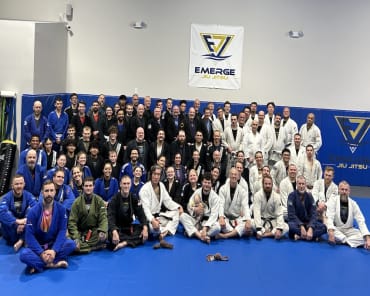
When we line up facing the coaches, higher ranks are to your right and lower ranks are to your left. Go by belt color first, then by stripes within the same belt when you can. If everyone in class is a white belt, the four-stripe white belts go furthest to the right and the white belts without stripes go furthest to the left.
Put your toes on the line, stand shoulder to shoulder and get quiet. At the beginning of class, that’s a chance to settle down and get your mind on the lesson. At the end, give the bow-out the same attention. When we shake hands afterward, take a moment to thank the people you just trained with.
3. Giving a Good Handshake
This seems like a small thing, but I think it’s important that kids and adults learn to give a proper handshake. Normally you use your right hand. Bring the web between your thumb and index finger firmly against the same part of the other person’s hand. Look them in the eye and say something to them. “Hello, Coach.” “Good job.” “Thanks for training with me.”
If you don’t know their name, this is a good time to ask. “My name is Don. What’s yours?” You can do all of that in a few seconds, and it means more than a quick slap of the hands as you walk by.
4. Greeting Coaches and Teammates
I’m a stickler on this one, especially with our kids. Call your coach “Coach.” If you know their name, “Coach Jennifer” or “Coach Tim” is great. If you don’t, “Coach” works just fine. With your teammates, learn their names and use them. A new student might know very few people in the room, and a simple hello and an introduction can make a difference.
In jiu jitsu, black belts have earned the title “Professor.” You’re welcome to use it at Emerge. When I visit another school, I usually call a black belt “Professor” until I learn what they prefer.
Among adults who know each other well, first names are often fine. I’m happy for my friends to call me Don. But when Brian is running a class and I’m taking it, I call him Coach Brian. I do that even if I outrank the person teaching. They’re responsible for the class, and I’m there to learn from them. I think that’s a good habit for kids to take with them, whether they’re talking to a teacher, a supervisor or somebody they’ve just met.
5. Being a Good Training Partner
What makes somebody a good training partner? For me, it starts with caring about the person you’re working with. You want them to be safe, to learn something and to enjoy the time they spend training with you. That starts while the coach is demonstrating. If you’re paying attention, you and your partner can get right to work when it’s time to drill.
When it’s time to roll, give your partner an honest effort. You can be competitive and still use good technique and self-control. I used to train with a guy who went for the same two moves almost every time. He was good at them. After a while I learned to defend them, and I kept wondering what else he might get good at if he gave himself a chance to try it. I think that’s worth asking ourselves. Am I willing to try something I’m still learning, even if I might get swept or tapped for it?
People want to train with somebody they can trust. If you regularly roll so hard and so fast that your teammates worry about getting hurt, they’ll start choosing other partners. I think that’s one way good etiquette shapes the culture of a gym. When people take care of each other, it’s easier for everyone to train hard and keep coming back.
6. Respecting the Tap
Respecting the tap goes both ways. If you’re caught in an armbar and your partner has you in checkmate, tap before you get hurt. Then tell them “good job,” reset and go again. You might even ask how they caught you. There’s a lot to learn in that moment if you’re willing to ask.
If you’re the one applying the submission, give your partner plenty of time to tap and release as soon as they do. You can get to the position quickly and still finish with control. If your partner is caught and hasn’t tapped, you can let go and keep training. You already know you got there.
Think about what both people are practicing in that exchange. You respect your partner enough to protect them. You have the humility to tap when they catch you. And you’re grateful that there’s somebody willing to get on the mats and help you get better. That’s what I hope our kids and adults carry out of the dojo with them. The next time you train, pay attention to what you’re doing for the person across from you. Are they getting as much out of the round as you are?