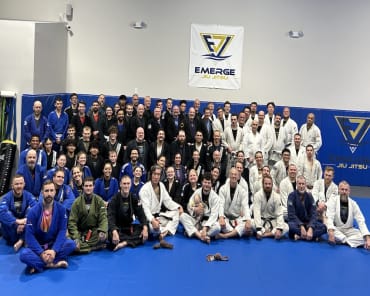
Respecting the Belt: Etiquette Between Training Partners
When I started my formal jiu-jitsu training 17 years ago, we trained without the gi. For the first couple of years, there were no belts in the room. But we still knew who the senior guys were. You could recognize them by how they rolled, their wisdom, and the way they carried themselves.
After moving and changing gyms, the training schedule more or less forced me to put on the gi. To this day, I’m grateful for that. I love training in the gi.
With the gi, of course, came belts. I put on a white belt. There was plenty for me to learn, and I considered it an honor and a privilege to train with those who had more experience.
That attitude is something I want our teammates at Emerge to consider. What does it mean to respect the belt? How should that respect affect the way we ask someone to roll, respond to an invitation, and care for one another as training partners?
What I Learned Coming Up
In the gyms where I trained, there was generally an understanding that you let an upper belt ask you to roll. Depending on the gym and the relationship, asking someone of higher rank could be interpreted as calling them out.
How you asked mattered. Your attitude mattered. And whether that person knew you mattered.
If you didn’t know an upper belt, you usually waited for an invitation. As a relationship developed and trust grew, asking became more natural. They understood that you respected them and wanted to learn.
I remember a purple belt teammate joking with our Brazilian black belt, Coach Pedro, saying something along the lines of, “Oh, Pedro doesn’t want to roll with me.”
Pedro rolled with him.
It was a very long round for our teammate. At one point, I kid you not, our teammate's feet hit ceiling in the training room as Pedro launched him through the air. Our teammate survived without injury, and as far as I know, he didn’t make that joke again.
That story illustrates the culture I came up in, but it also illustrates why the way we communicate matters. In that environment, especially with a Brazilian black belt, even a joking suggestion that someone was afraid to roll could be understood as disrespectful. That expectation is part of the traditional jiu-jitsu culture many of us learned in.
When you know someone well and have an established friendship, you may be able to joke that way because you understand each other. Without that relationship, you should not assume your words will be received in the spirit you intended.
And when I say disrespect, I’m not talking about a lower belt tapping an upper belt. Applying good jiu-jitsu and catching a submission is part of training. I’m talking about how you speak to someone, the attitude you communicate, and the energy you bring into the interaction.
We also train in a combat sport. There are different levels of intensity, and an experienced upper belt can make a round very difficult through controlled pressure and technique while still protecting their partner. A hard round can be uncomfortable—even miserable—without being unsafe. Right or wrong, if you approach someone as though you are calling them out, you may find that they respond with a much more serious and less playful round than you expected.
That does not excuse ignoring a tap, causing injury, or disregarding an agreed level of intensity. Self-control remains the responsibility of every training partner.
But the first lesson here is to show respect in how you approach people. Don’t put a teammate in the position of having to decide whether your joke is friendly or whether you are challenging them. Take time to build the relationship. Approach them with humility, and show appreciation for the opportunity to train together.
An Invitation Is an Opportunity
As I came up through the ranks, if an upper belt asked me to roll, I was eager to accept.
I knew it might be difficult. I knew I would probably spend a good part of the round defending, escaping, and tapping. But I also understood that this was an opportunity to learn from someone who knew things I needed to learn.
I can hardly think of a time in almost two decades when I declined an invitation from someone of higher rank, other than being injured or so exhausted that I needed to stop training altogether.
That has been my personal approach. It has benefited me, and I want to encourage our students to appreciate those opportunities too.
When an upper belt asks you to roll or drill, consider what they are offering: their time, experience, and attention. You may feel weaknesses in your game that your usual partners don’t expose. You may experience control, timing, and technique that help you understand what you are working toward.
There is a lot of value in that.
A Challenge for Our Team
As Emerge approaches ten years, I recognize that our culture is somewhat different from the one I came up in. Many of our students are comfortable asking anyone to roll.
I appreciate the friendships and approachability we have here. I also want us to preserve respect for experience and a willingness to learn from those who have gone before us.
Sometimes I see students decline an invitation from an upper belt or appear to avoid those rounds. I see it among both kids and adults.
I don’t always know the reason, and I shouldn’t assume that I do. There may be an injury, a concern about intensity, or something else I’m unaware of.
But I want to challenge you to examine your own reasons honestly.
Are you avoiding that round because you have a concern about safety or your ability to train productively? Or would you simply rather roll with your friend? Are you choosing a partner who will help you work on something specific, or are you choosing someone easier because you don’t want to struggle?
We all enjoy comfortable training relationships. Those relationships are a good part of our gym. But if you want to progress, you also need to be willing to experience difficulty.
Especially as you move beyond the beginner stage, I encourage you to welcome opportunities to train with upper belts. Sometimes that means setting aside your preference for your favorite partner and accepting a round that will ask more of you.
Respect and Deference
By deference, I mean giving thoughtful consideration to someone’s experience and judgment.
An upper belt may have particular training needs. They may be choosing partners based on size, skill, intensity, or something they are working to improve. If you ask them to roll and they decline, accept that graciously. They may have a reason you know nothing about.
When an upper belt invites you, I encourage you to give that invitation serious consideration. Their experience may allow them to recognize a useful training opportunity that you don’t yet recognize yourself.
That doesn’t mean every upper belt always knows what is best for every lower belt. But experience deserves a humble hearing.
You can ask respectfully: “Would you like to roll?” or “If you’re available, I’d appreciate a round.”
Then give them room to answer. There is no need to pressure, tease, or question their willingness.
And if you have already committed to another partner, honor that arrangement or communicate clearly with both people before changing it. Respect for rank should go together with being considerate toward every teammate.
You Still Have the Right to Say No
In my earlier post about being a good training partner, I explained that everyone has the right to decline a roll. That remains true, regardless of belt rank.
You do not have to accept a roll because someone outranks you. You do not owe a public explanation, and saying no should not result in punishment, ridicule, or pressure.
At the same time, I encourage you to think about your training habits. Having the freedom to decline and being willing to challenge yourself can exist together.
A single declined round tells us very little. A pattern of avoiding everyone who challenges you may be worth examining.
My encouragement is to approach those opportunities with humility, gratitude, and a willingness to learn.
When There Is a Problem, Seek a Way Forward
Sometimes the reluctance to roll has a real cause.
Maybe a partner applies submissions too quickly. Maybe their intensity keeps escalating. Maybe you have asked them to slow down, but nothing changes. A higher belt does not automatically make someone a trustworthy training partner.
If something is preventing you from training comfortably with a teammate, consider whether it can be addressed.
If you feel comfortable speaking with them, be specific:
“I’d like to train with you, but I need a slower pace.”
“Last time, that submission came on before I had time to tap. I need more time to respond.”
You can also speak privately with a coach. You do not have to handle a difficult conversation by yourself, and you do not have to confront someone directly before asking us for help.
Communication gives us a chance to resolve problems. It may help someone become a better partner and allow both of you to benefit from training together.
If the problem cannot be resolved, you still have the right to decline.
Upper Belts Have Responsibilities Too
If we expect lower belts to respect experience, those with experience ought to demonstrate why that respect matters.
An upper belt should be developing patience, awareness, and self-control alongside technical skill. We should be learning how to give different partners productive rounds without making every round a test of our superiority.
If people regularly avoid training with you, take an honest look at how you roll.
Are your submissions controlled? Do you listen when someone asks you to slow down? Can you adjust to a smaller, older, less experienced, or injured partner? Do you become upset when someone matches the intensity you brought into the round?
Sometimes people who struggle to find partners are unaware of how rough they are. Sometimes they have heard the feedback but haven’t changed.
Ask your coach. Ask a teammate you trust to be honest. Then be willing to listen.
As I have said before, trust is earned through our behavior. Our belt should be accompanied by conduct that gives others confidence in us.
Make the Most of the People Around You
I want our students to appreciate the knowledge and experience available on these mats.
If an upper belt is available to drill, respectfully ask to partner with them. If they invite you to roll, make an effort to accept when you can. Be willing to struggle, ask questions, and learn.
Upper belts, make those opportunities worthwhile. Be the kind of training partner people can trust. Respect a declined invitation and keep demonstrating care through your actions.
At Emerge, respect, humility, and gratitude ought to be visible in how we train together.
Respect the years someone has invested. Have the humility to learn from them. Be grateful for teammates who give their time and effort to help you improve.
And whatever belt you wear, do your part to help the people around you grow.
—Coach Don